

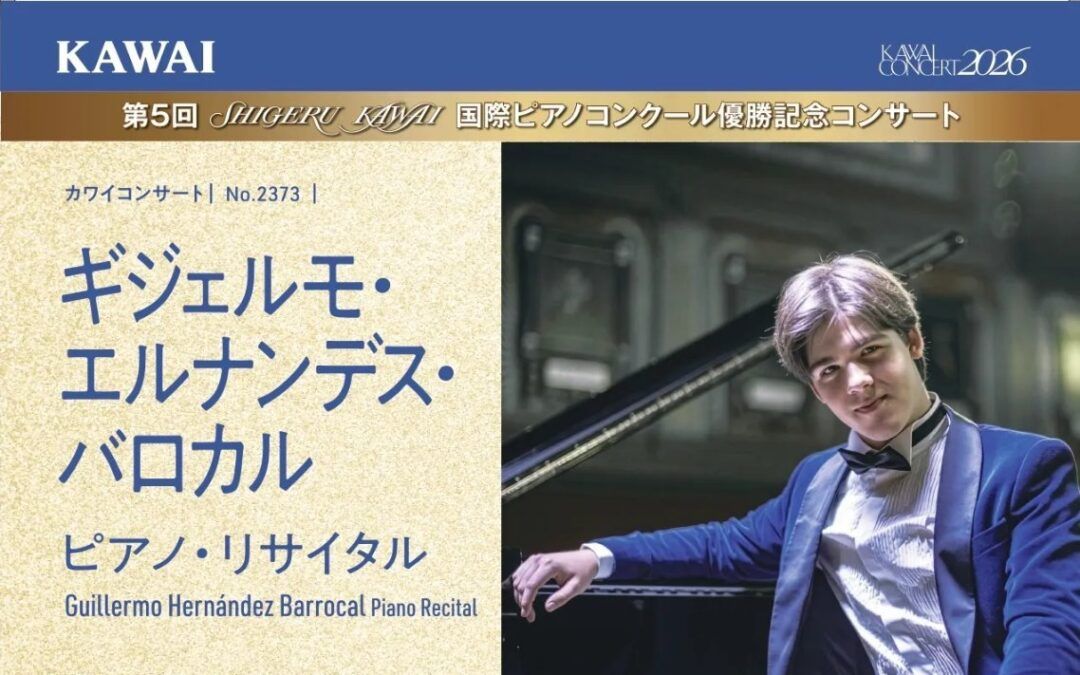
From 21 to 25 August 2026, Guillermo returned to Japan for the recital tour Kawai gives the winner of the Shigeru Kawai International Piano Competition. A year after taking First Prize and the Audience Award in Tokyo, he played four cities on a Shigeru Kawai SK-EX concert grand and closed the tour on 25 August at Ginza Oji Hall in Tokyo.
Four stops
- 21 August: Osaka, Kawai Umeda Concert Salon
- 22 August: Nagoya, Kawai Nagoya Concert Salon
- 23 August: Sendai, Kawai Sendai Concert Salon
- 25 August: Tokyo, Ginza Oji Hall
The programme
First half: Chopin, Tarantelle in A-flat major, Op. 43, and Ballade No. 1 in G minor, Op. 23; Brahms, Piano Sonata No. 1 in C major, Op. 1.
Second half: Schumann, Carnaval, Op. 9; Stravinsky, Three Movements from Petrushka.
In Tokyo the audience got three encores: a paraphrase of Beethoven’s Turkish March, Schumann-Liszt’s Widmung, and another piece by Guillermo himself.
Kawai’s report on the Tokyo recital
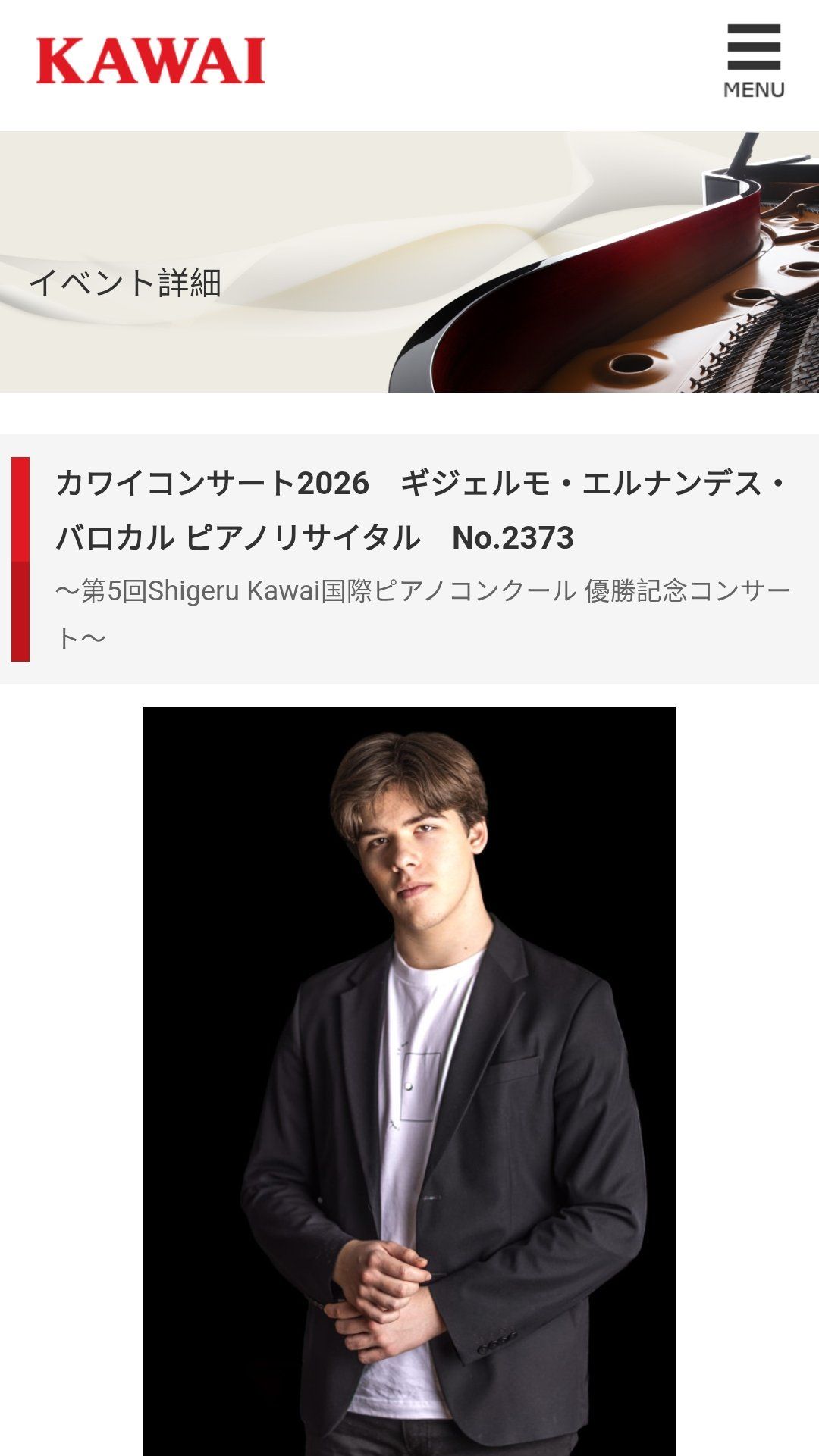
The concert page on Kawai’s website.
In her write-up for Kawai, Tomoko Shinhara takes the recital piece by piece. She highlights the lightness of the Tarantelle, every note crystal clear from the first bar; a First Ballade that builds from stillness; a dense, almost orchestral Brahms; a Carnaval where each piece brings a new character to the stage; and a Petrushka full of driving rhythms and fiendish leaps, played without forcing the sound and brilliant right to the end.
The report describes an enthusiastic audience and a long ovation, and points to the technical and expressive maturity of an 18-year-old. Introducing the concert, Kawai had already called him one of the most promising young pianists on the international scene.
One year earlier, at the final
The tour closes a circle that opened in August 2025. After the competition final, music writer Haruka Kosaka wrote in eBravo that his performance, “full of the joy of music and positive energy, captivated many people”.
Thank you to Kawai, to PTNA (Piano Teachers’ National Association of Japan), which supported the Tokyo concert, and to everyone who came to listen in Osaka, Nagoya, Sendai and Tokyo.
Links
- Kawai: report on the Ginza Oji Hall recital (Japanese)
- Kawai: Tokyo concert page (Japanese)
- Shigeru Kawai International Piano Competition: winner’s concert tour
- PTNA: Tokyo concert (Japanese)
- ONTOMO: Nagoya concert (Japanese)
- eBravo: review of the 2025 final (Japanese)
